



BitteBitteJaJa (Ulu Braun & Roland Rauschmeier) has been working as an artist duo since 1997, developing a practice defined by an open approach to image material, montage and narration. Their work unfolds as an ongoing process rather than aiming toward a fixed outcome. Combining their own material with found footage, they create shifting visual constellations in which elements overlap, displace one another, and only gradually take shape. Their works have been presented internationally in galleries and museums.
A key aspect of their approach lies in the deliberate reduction of controlled authorship. Instead, they employ methods that allow chance, association, and displacement to become active forces within the work. This openness informs the evolving series Cadavres Exquis Vivants, which draws on the surrealist principle of the cadavre exquis and translates it into a contemporary context.
Alongside this series, BitteBitteJaJa produced experimental films that pursue similar strategies of layering, montage, and open narration. Their body of work resists closure and instead remains in a constant state of becoming.
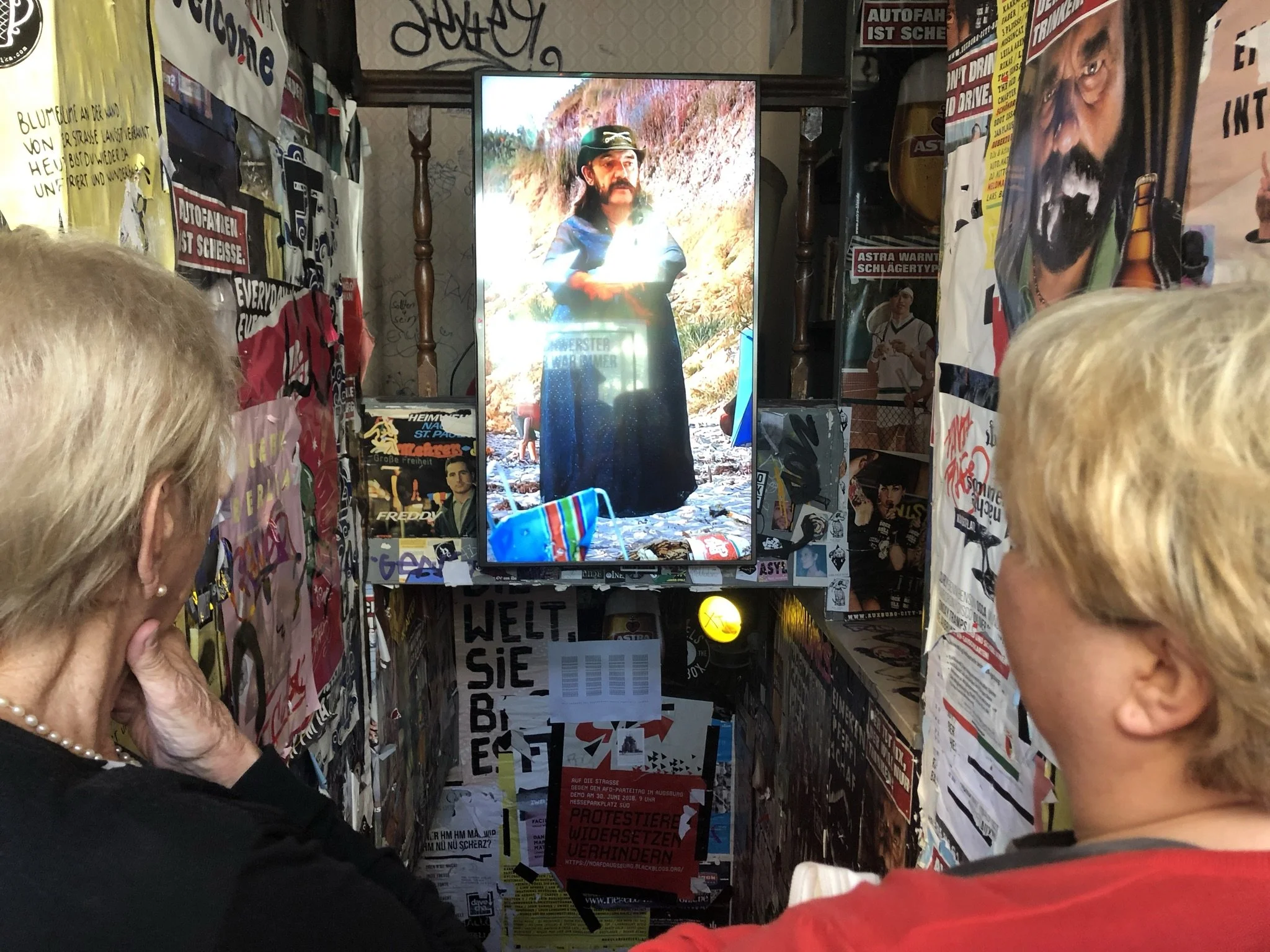
Cadavres Exquis Vivants unfolds as an ongoing series of short video portraits. Initiated around 2007 and continuously developed since, the works take the form of condensed video collages in which historical and cultural figures appear as newly constructed characters, fully immersed in specific actions.
The series draws on the surrealist method of the cadavre exquis, a collective practice based on chance and discontinuity. Translated into the digital realm, BitteBitteJaJa combine found footage and self produced material to construct dense visual compositions. The figures are situated in absurd, often dreamlike settings where narrative coherence dissolves into associative micro dramas.
In this process, portraiture becomes the construction of an alternate reality. Recognizable identities are deconstructed and reassembled, oscillating between caricature, fiction, and symbolic projection. Through an emphasis on instability and transformation, the works destabilize fixed conceptions of subjectivity and extend the strategies of modernist surrealism into the realm of the contemporary moving image.
“[With the] exquisite corpse we had at our disposal – at last – an infallible means of sending the mind’s critical mechanism away on vacation and fully releasing its metaphorical potentialities.”
André Breton, “Le message automatique,” in La Révolution surréaliste, no. 3, 1925.
Reprinted in: André Breton, Œuvres complètes, vol. I, Paris: Gallimard (Bibliothèque de la Pléiade), 1988.
The Cadavre Exquis is a collaborative method that began with the Surrealists in the 1920s. Instead of focusing on individual control, it emphasizes a shared process. Several people create a drawing or text step by step, each responding only to a small part of what came before.
This way of working produces results that are often unexpected. Images and ideas do not fully connect, and meanings stay open. Rather than forming a single, unified work, the pieces remain fragmented, allowing surprising combinations and associations to emerge.
For RauscHmeier and Braun, this method also made it possible to continue working together across distance. Living in different European cities, the principle of Cadavre Exquis helped them sustain a shared artistic process over time, despite not being in the same place.
SERENGETI MUST NOT DIE
Real - time animation
8:30 min, Stereo, mini-DV
1999
This work is a real-time animated fairytale based on the plane crash of Michael Grzimek, son of the famous German zoologist Bernhard Grzimek, who died in a plane crash in the Serengeti in 1959. The film of the same name was the first German film to win the Oscar in the category ‘Academy Award for Best Documentary Feature’, and the book has been translated into more than twenty languages. The Serengeti Must Not Die freely interprets the events after the crash and explores topics such as natural selection, the domination of nature, or post-colonialisation. The video received an honourable mention at the Sehsüchte Festival in Berlin in 2000. The overall work took a long time to realise, despite the seemingly simple technical implementation.
INTERFERING WITH WORKS OF OTHERS
18:19 min, Stereo, mini-DV
2004
This documentary is of a public painting project that took place at the Berlinische Galerie in Berlin/Germany in 2004. The project was added to an existing exhibition and followed the idea of six invited artists painting a large canvas placed in the middle of the space. There were no content or aesthetic guidelines. There was only a group concensus to finish within a certain time and to allow a mutual reworking of the painting itself. After the scheduled time had elapsed, the painting was to remain in its current state.
Afterwards, one of the participating artists was asked by a spectator if she could also contribute to the work. He agreed without the consent of the others and the woman drew a continuous red line from left to right across all canvases. This act caused a controversy amongst the participating artists that included the autonomy of the artwork, the trust in each other, the idea of authorship, restoration efforts of the failed artwork, or damaging further exhibits.
The evening had several twists and turns and was driven by anger, frustration and the exchange of individual ethics to find common artistic gestures in an artificial construct.
REKORDER
19:53 min, Stereo, mini-DV
2007
Rekorder (guide through the heart again) is a cinematic collage which unifies the Present and the History to construct an artistic approximation of the concept of ‘Africa’. The narrative of the video was developed during its filming and was subject to improvisation. The producers and actors were identical and the working process was uncovered and themed. In addition to green screen footage, material was used from a media archive created from Ulu Braun across all media platforms.
The first part of Rekorder focuses on the technical and creative conditions of media production. The difficulties with hardware and software are revealed in a documentary form and symbolise the sometimes-bumpy process from the initial idea to the end result. In principle, it is about the assertion that one can create artistic works about anything, regardless of whether it is perceived as valid. In the middle section of the collage, mysticism, reality, analysis and fiction increasingly merge into a dense sequence of mutually dependent images. In the last section, poetic images intertwine with art-historical quotations supported by Bach’s Cantata 106 Gottes Zeit ist die allerbeste Zeit.
In this work, sovereignty of feelings plays a larger role than a binding intellectual approach.
Maria Theresia and her 16 children
29:27 min, Stereo, HDV
2011
This video collage draws on sixteen portraits of Maria Theresia’s children, combining lesser known historical facts about their lives with a dense and multilayered visual composition. Historical and scientific film material is interwoven with commercials and ethnographic imagery, all of which is digitally transformed. Conventional visual codes and genre boundaries are deliberately disregarded, allowing disparate image worlds to collide and generate new associative meanings.
Pop cultural figures move through eighteenth century royal gardens, while living exotic birds overlay what appears to be the Habsburg coat of arms. Individual image sequences repeatedly reference places and achievements connected to the imperial offspring, only to be rapidly overtaken by an accelerating flow of images. This constant layering and replacement creates a dynamic structure in which meaning emerges through juxtaposition rather than linear narration.
Images of sporting events and industrial labor counterpoint archival footage of Emperor Franz Joseph. Exotic scenes from Brazil intersect with biographical references, while idealized athletic bodies allude to Marie Antoinette and are subsequently reframed through radical artistic positions such as those associated with Hermann Nitsch. Drawing on the history of moving images as its primary material, the work reorganizes historical narratives and constructs a speculative perspective on Austria’s future.